Category: Camping Gear > Shelter & Sleep Parent pillar: Shelter & Sleep Guide (link-to-pillar-page) Hub article: 10 Camping Gear Mistakes That Ruin Your Trip (link-to-hub-article) Previous sub-topic: Best Tents for Wide Camping (link-to-subtopic-1) Primary keyword: family tent vs backpacking tent Secondary keywords: Word count: ~3,300 words Intent: Commercial investigation / Buyer’s guide Affiliate opportunity: Family tent pick, backpacking tent pick, crossover tent pick + accessories
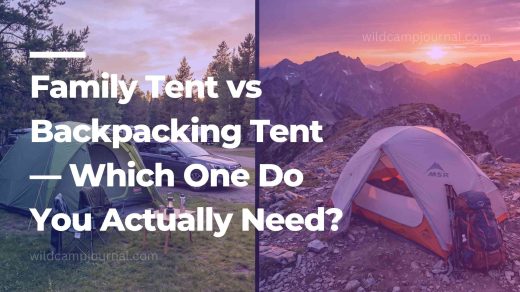
You’ve decided to go camping. You’ve decided you need a tent. And then you’ve opened a browser tab, typed “camping tent” into a search bar, and immediately found yourself staring at two completely different categories of product that look nothing like each other — one the size of a small studio flat, the other the size of a stuff sack you could fit in a school bag.
Table of Contents
Family tents and backpacking tents are both tents. That is roughly where the similarities end. They are designed for different purposes, different people, and different camping experiences — and buying the wrong one for your style of camping is one of the most common and most expensive gear mistakes beginners make.
This guide breaks down every meaningful difference between family tents and backpacking tents across seven key factors — weight, size, packed dimensions, weather protection, setup, durability, and price. By the end, you will have a clear framework for deciding which tent type matches how you actually camp, along with specific product recommendations across all three categories.
Let’s start by defining exactly what each tent type is — and who it is built for.
Prefer to watch first? REI’s gear team explains the core differences between car camping and backpacking tents in under 8 minutes.
What Is a Family Tent?
Definition and Key Characteristics
A family tent is a large, spacious shelter designed primarily for car camping — where you drive to your campsite, unload your gear, and set up for one or more nights without carrying the tent any significant distance.
Family tents prioritise living space above all else. They typically feature near-vertical walls that maximise usable floor area, generous peak heights that allow adults to stand and move around comfortably, and floor areas large enough to fit multiple sleeping systems with room left over for gear, clothing, and the general chaos of camping with children.
Capacity ratings on family tents run from 4-person at the lower end up to 12-person or more for large group shelters. As we covered in our guide to common tent buying mistakes, these ratings are based on maximum sleeping bag occupancy with no gear — so a family of four realistically needs a tent rated for six, and a group of six needs one rated for eight or more.
Weight in a family tent is not a design priority. When you are loading gear into a car boot, an extra three kilograms of tent is irrelevant. This means family tent manufacturers can use heavier, more durable fabrics, more robust pole systems, and more generous proportions without compromising the product’s usability.
Who Family Tents Are Built For
Family tents are the right choice for:
- Families with children who need space to move, play, and store gear indoors
- Groups of friends camping together at established campsites
- Campers who drive to their pitch and stay for two or more nights
- Anyone who values comfort, standing room, and organised living space over portability
- Couples who want a genuinely comfortable sleeping environment without the constraints of a minimalist shelter
If the journey to your campsite ends at a car park or a designated pitch with vehicle access, a family tent is almost certainly the right tool for the job.
Typical Features of a Family Tent
Family tents come with features that backpacking tents simply cannot accommodate due to weight and size constraints:
Multiple doors and windows — Large family tents often have two or more doors, reducing the bottleneck of everyone entering and exiting through one opening. Multiple mesh windows improve ventilation and reduce condensation significantly.
Room dividers — Many mid-range and premium family tents include a fabric divider that splits the interior into two sleeping compartments, giving adults and children separate spaces and improving privacy on longer trips.
Gear loft and interior pockets — Integrated mesh pockets and overhead gear lofts keep torches, phones, books, and small items organised and off the floor — a feature you will appreciate enormously by night two.
Large vestibule or awning — A substantial covered porch area for storing muddy boots, wet gear, and backpacks is standard on quality family tents. Some models include an extendable awning that creates a shaded outdoor living area.
Electrical cable port — Many family tents include a small port in the fabric specifically for passing an electrical cable through, allowing you to power a light, phone charger, or small appliance when camping at a site with electric hookups.
What Is a Backpacking Tent?
Definition and Key Characteristics
A backpacking tent is a compact, lightweight shelter designed to be carried inside or strapped to a hiking backpack for the duration of a multi-day walking trip. Where a family tent is optimised for living space, a backpacking tent is optimised for pack weight and pack size — every gram and every cubic centimetre matters.
Backpacking tents are typically designed for one to three people, with floor areas sized to fit sleeping bags and little else. Many sacrifice standing height entirely — you enter on hands and knees and sleep horizontally. This is not a design flaw; it is a deliberate trade-off that saves hundreds of grams of fabric and pole material.
Pole systems in backpacking tents tend toward simplicity and speed — fewer poles, lighter materials (aluminium and, at the premium end, carbon fibre), and designs that allow a single person to pitch the shelter quickly, in low light, on uneven terrain, after a long day on trail.
Who Backpacking Tents Are Built For
Backpacking tents are the right choice for:
- Solo hikers and trail runners who carry everything on their back
- Couples doing multi-day wilderness or long-distance trail routes
- Campers who move to a new pitch location on consecutive nights
- Ultralight enthusiasts for whom every gram of pack weight is a conscious decision
- Experienced campers doing remote or backcountry camping in exposed locations
If you are hiking to your campsite — even for a relatively short distance — the weight and packed size of your tent becomes a meaningful constraint. A backpacking tent solves that constraint. A family tent does not.
Typical Features of a Backpacking Tent
Lightweight aluminium or carbon fibre poles — Backpacking tent poles are engineered to the minimum weight required to hold the shelter’s structure. Carbon fibre poles, found on premium ultralight models, save significant weight over aluminium but cost considerably more and are less forgiving if bent or stressed.
Minimal vestibule — Most backpacking tents include a small covered vestibule just large enough to store a pair of boots and the top of a pack. It keeps wet gear out of the sleeping area without adding unnecessary fabric weight.
Single or double-wall construction — Some ultralight backpacking tents use a single-wall design (no separate inner tent and flysheet) to save weight. Single-wall tents are lighter but manage condensation less effectively than double-wall designs. For three-season backpacking in variable weather, a double-wall tent is the more practical choice.
High packability — A quality backpacking tent packs down to a stuff sack the size of a large water bottle and weighs between 0.8kg and 2.5kg for a two-person model. It fits inside a 65-litre backpack without dominating the available space.
Low profile — The low, aerodynamic silhouette of a backpacking tent is not only a weight-saving measure — it also performs better in high wind than the large vertical-walled profile of a family tent, which catches wind like a sail.
Family Tent vs Backpacking Tent — 7 Key Differences
1. Weight
This is the most dramatic difference between the two tent types and the one that matters most for how you use the shelter.
A typical family tent weighs between 6kg and 15kg — and some large cabin-style models weigh more. When you drive to a campsite and carry the tent thirty metres from your boot to your pitch, this weight is completely irrelevant.
A typical backpacking tent weighs between 0.8kg and 2.5kg. When you are carrying that tent for fifteen kilometres a day in a pack that also contains your sleeping bag, food, water, clothing, and stove, the difference between a 1.2kg tent and a 1.8kg tent is a decision you think about carefully.
The practical takeaway: if you are not physically carrying your tent any meaningful distance, weight is not a factor in your buying decision. If you are carrying it on your back, weight is arguably the most important factor.
2. Size and Living Space
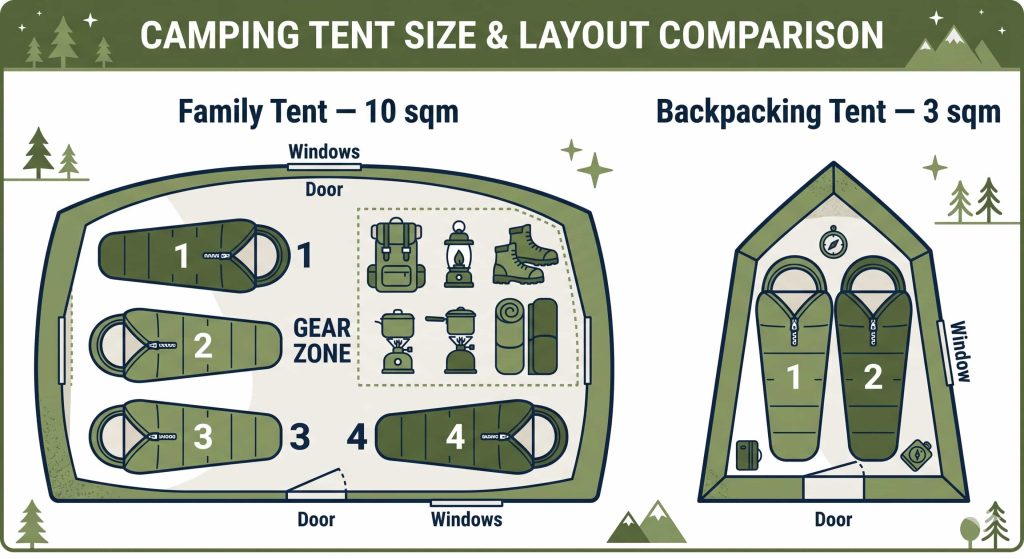
A large family tent offers a floor area of 8 to 20 square metres — enough for a family of four to sleep, store gear, change clothing, play cards, and generally live in for multiple days without feeling confined.
A two-person backpacking tent offers a floor area of roughly 2.5 to 4 square metres — enough for two sleeping bags and minimal personal gear, with nothing spare.
The standing height difference is equally significant. Most mid-range and premium family tents offer a peak height of 180–200cm — enough for an average adult to stand fully upright throughout most of the interior. Most backpacking tents offer a peak height of 90–110cm — sit-up height at best, crawl-in height at worst.
On a single overnight trip in good weather, these differences are manageable. On a four-night trip with two children, bad weather keeping everyone inside, and gear spread across the tent floor, they become the difference between a functional camping experience and a miserable one.
3. Packed Size
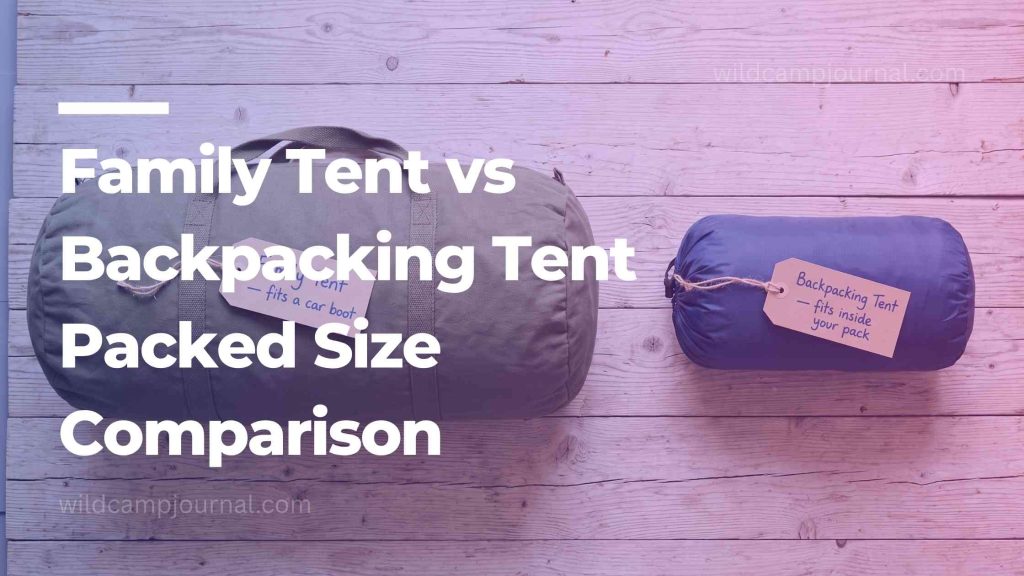
A family tent packs down to a long cylindrical bag roughly the size of a large golf bag. It fits comfortably in a car boot, takes up most of the boot in smaller vehicles, and is not something you could carry on your back for any meaningful distance.
A backpacking tent packs down to a stuff sack roughly the size of a 2-litre water bottle. It fits inside a backpack, can be strapped to the outside if needed, and adds negligible bulk to any carrying system.
For wide camping — where you drive to your pitch — packed size is irrelevant. For trail camping — where every cubic centimetre of pack space is allocated — it is everything.
4. Weather Protection
This is where the comparison becomes more nuanced than most buyers expect.
Family tents are generally weatherproof in moderate conditions — a quality family tent with a 2,000–3,000mm HH rating will keep you dry in heavy rain. However, the large vertical-walled profile of a family tent is vulnerable to strong wind in a way that a low-profile backpacking tent simply is not. A gust that a backpacking tent deflects with its aerodynamic silhouette will push hard against the broad face of a family tent, stressing the poles and guylines.
Backpacking tents, by contrast, are built to be pitched in exposed locations where wind and weather are genuine concerns. Their lower profile, stiffer pole geometry, and closer guyline spacing make them significantly more wind-resistant per square metre of floor area than any family tent.
The practical takeaway: for established campsites in sheltered locations, a family tent provides excellent weather protection. For exposed wild camping, ridge camping, or any pitch where weather conditions are unpredictable, a backpacking tent is the safer shelter.
5. Setup Time and Complexity
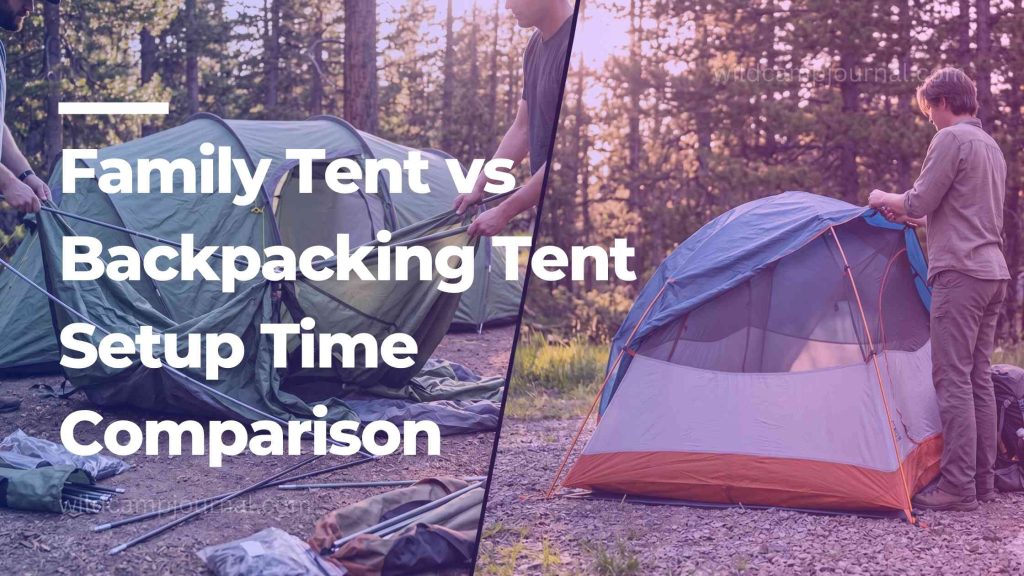
A family tent typically takes 20–40 minutes to pitch from scratch and benefits from two people — one to hold poles while the other clips fabric, one to peg out guy lines while the other adjusts tension. After several trips the process becomes faster, but it rarely becomes a one-person, ten-minute job.
A backpacking tent is designed to be pitched solo, in the dark, at the end of a long hiking day, possibly in rain. Most experienced backpackers can pitch their tent in 5–10 minutes. The pole systems are simpler, the clips are faster to engage than sleeve systems, and the overall architecture involves fewer components.
First time pitching a tent? This step-by-step video shows exactly what to expect before your first campsite setup
For wide camping, setup time is rarely critical — you have daylight, time, and probably a second pair of hands. For trail camping where you arrive at a pitch in fading light after a full day of hiking, a tent that goes up in seven minutes versus one that takes thirty is a meaningful quality-of-life difference.
6. Durability and Lifespan
Family tents use heavier denier fabrics that resist abrasion, UV degradation, and general wear better than the lightweight fabrics used in backpacking tents. A quality family tent used 4–6 times a year and stored correctly will last 8–12 seasons without significant deterioration.
Backpacking tents use thinner, lighter fabrics that are more susceptible to abrasion from rocky ground and UV damage from extended sun exposure. A quality backpacking tent used regularly on trail will typically last 4–8 seasons, with the floor fabric showing wear first.
The trade-off is that backpacking tents, by virtue of their use case, are often exposed to more demanding conditions than family tents — rocky pitches, higher winds, greater temperature swings — which accelerates wear regardless of fabric quality.
7. Price
Entry-level family tents start at around $70–$80 and offer adequate performance for occasional summer camping. Mid-range family tents ($150–$300) offer genuinely good weather protection, aluminium poles, and features that make multi-night trips comfortable. Premium family tents ($350–$600+) offer best-in-class waterproofing, superior pole geometry, and a level of interior organisation that transforms the camping experience.
Backpacking tents start at around $100 for budget models with fibreglass poles and compromised waterproofing, and run to $600–$800 for premium ultralight models from brands like Big Agnes, MSR, and Nemo. The price curve in backpacking tents is steep — you pay a significant premium for each hundred grams of weight saved, and the most dramatic weight savings come at the very top of the price range.
For most buyers, a mid-range option in either category delivers the best value for money.
Head-to-Head Comparison Table
| Feature | Family Tent | Backpacking Tent |
|---|---|---|
| Typical weight | 6–15kg | 0.8–2.5kg |
| Capacity | 4–12 person | 1–3 person |
| Floor area | 8–20 sqm | 2.5–4 sqm |
| Standing height | Yes — most models | Rarely |
| Packed size | Large — car boot | Small — backpack |
| Setup time | 20–40 minutes | 5–15 minutes |
| Weather resistance | Moderate — good | Good — excellent |
| Wind resistance | Moderate | High |
| Price range | $70–$600 | $100–$800 |
| Durability | 8–12 seasons | 4–8 seasons |
| Best use case | Car camping, families | Hiking, trail camping |
Which Tent Type Matches Your Camping Style?
Choose a Family Tent If…
- You drive to your campsite and park within carrying distance of your pitch
- You camp with children or a group of three or more people
- You stay at one pitch for two or more consecutive nights
- Comfort, standing room, and organised living space matter to you
- You camp at established sites with vehicle access and level pitches
- Weather protection in moderate conditions is sufficient for your trips
- You want a tent that will last a decade with proper care
A family tent is the right choice for the vast majority of beginners and casual campers. It rewards you with space, comfort, and livability — and punishes you only if you try to carry it further than a car park.
Choose a Backpacking Tent If…
- You hike to your campsite carrying all your gear on your back
- You camp solo or with one partner
- You move to a new pitch location on consecutive nights
- Pack weight is a genuine physical constraint on your trips
- You camp in exposed, remote, or backcountry locations
- You need a shelter that pitches fast in low light or bad weather
- You are willing to sacrifice living space for portability and performance
A backpacking tent is the right choice for anyone whose camping style involves meaningful distances on foot. The discomfort of a cramped shelter is a reasonable trade-off for the freedom to camp anywhere you can walk to.
What If You Want to Do Both?
This is a genuinely common situation — particularly for campers who started with car camping and are beginning to explore hiking, or couples where one partner wants to hike and the other wants the comfort of a larger shelter.
The honest answer is that one tent cannot fully serve both use cases. A family tent is too heavy and too large to carry on a hiking trail. A backpacking tent is too small and too cramped to be a comfortable family shelter for multiple nights.
However, a well-chosen 3-person 3-season tent in the 1.5–2kg range can serve as a reasonable crossover option — light enough to carry on moderate-distance hikes, spacious enough for two adults with gear for a car camping weekend. It will not be as comfortable as a dedicated family tent, and it will not be as light as a dedicated backpacking tent, but it eliminates the need to own two separate shelters while you figure out which style of camping you prefer.
If you regularly do both and want each experience done properly, owning one tent of each type is the eventual solution. Start with whichever use case dominates your trips.
Can You Use a Backpacking Tent for Family Camping — or Vice Versa?
Backpacking Tent for Family Camping — The Honest Answer
For a couple who primarily backpacks and occasionally car camps, a backpacking tent works adequately for car camping. You accept the cramped space and low ceiling in exchange for not buying a second shelter.
For a family of three or four trying to use a two-person backpacking tent — it does not work. The floor space is too small for additional sleeping bodies, the condensation from multiple people in a poorly ventilated small shelter is severe, and the lack of gear storage creates a chaotic sleeping environment that nobody enjoys.
Family Tent for Backpacking — Why It Simply Does Not Work
The weight alone rules this out. Carrying a 10kg family tent on a hiking trail — in addition to a sleeping bag, sleeping pad, food, water, clothing, and stove — creates a pack weight that is physically exhausting and potentially damaging over any meaningful distance.
The packed size creates the second problem: most family tents, when compressed into their carry bag, will not fit inside a standard 65-litre backpack and are too awkward to strap to the outside reliably.
The third problem is the pole system. Family tent poles are designed to be assembled on flat ground by two people. Pitching one solo on a sloped, rocky backcountry pitch after a long day of hiking is an exercise in frustration that experienced hikers actively avoid.
The Crossover Option
If you genuinely want one tent that handles both use cases acceptably, look for a 3-person tent with the following specifications:
- Total weight under 2kg (preferably under 1.8kg)
- Aluminium poles
- Minimum 2,000mm flysheet HH rating
- Double-wall construction
- At least one vestibule
- Freestanding design
Tents meeting these criteria exist in the $200–$350 price range and represent a sensible starting point for campers who haven’t yet committed to one style of camping over the other.
Our Tent Recommendations by Camping Style
Best Family Tent Pick — Outwell Nevada 5P
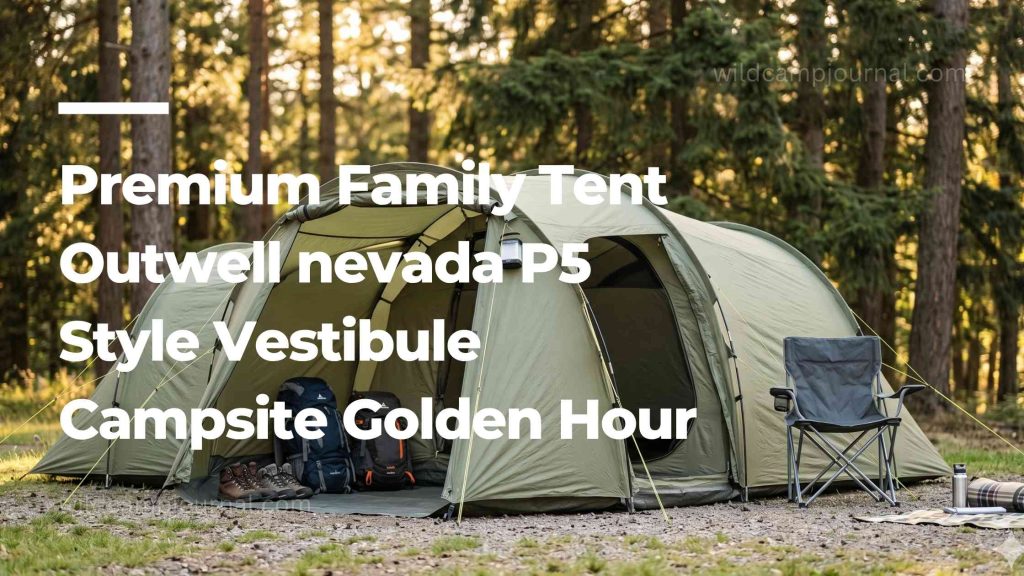
Price: $1,058.52 | Capacity: 5-person rated (fits family of 4 comfortably) Weight: 8.2kg | Flysheet HH: 3,000mm | Poles: Aluminium
The Outwell Nevada 5P delivers best-in-class weatherproofing, near-vertical walls with genuine standing height throughout, and a large front vestibule with an integrated groundsheet. It is the tent a family buys and uses for a decade.
Who it is right for: Families of 3–4 who car camp 4+ times a year and want a shelter that genuinely performs in variable weather.

Price: $1,058.52
Capacity: 5-person rated (fits family of 4 comfortably) Weight: 8.2kg
Flysheet HH: 3,000mm
Poles: Aluminium
Affiliate CTA: Check current price on Amazon → | Check at Blacks →
Best Backpacking Tent Pick — MSR Hubba Hubba 2
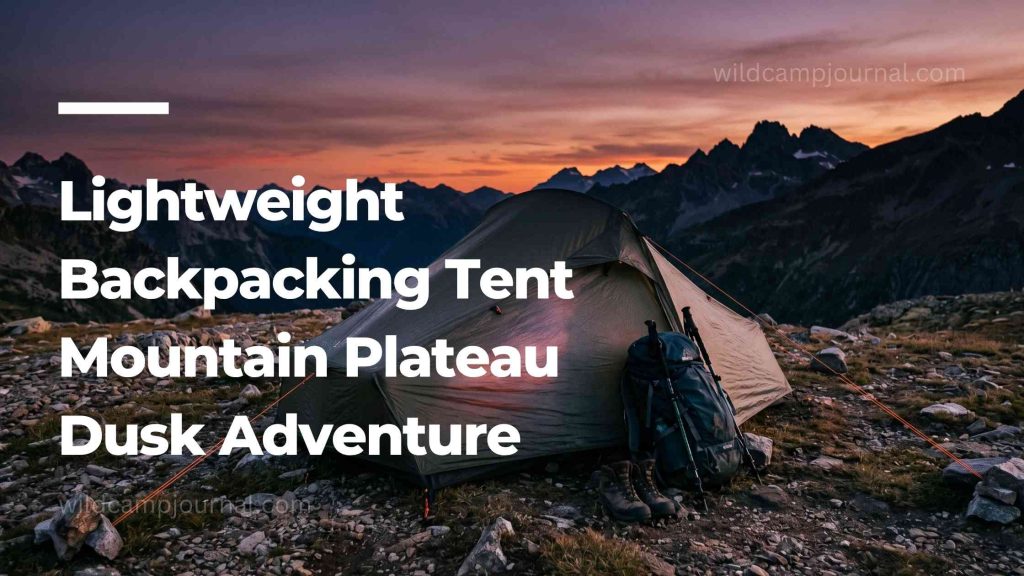
Price: $450–$500 | Capacity: 2-person | Weight: 1.36kg Flysheet HH: 1,500mm (3,000mm floor) | Poles: DAC aluminium
The MSR Hubba Hubba 2 is one of the most trusted two-person backpacking tents in the world — used by thru-hikers on the Appalachian Trail, PCT, and Te Araroa. The dual-door design eliminates the over-under scramble of single-door tents, and the structural design handles three-season weather reliably despite its low weight.
Who it is right for: Couples or solo campers who hike to their pitch and need a shelter that performs in exposed conditions without weighing down the pack.
Affiliate CTA: Check current price on Amazon → | Check at REI →
Best Crossover Pick — Vango Blade 200
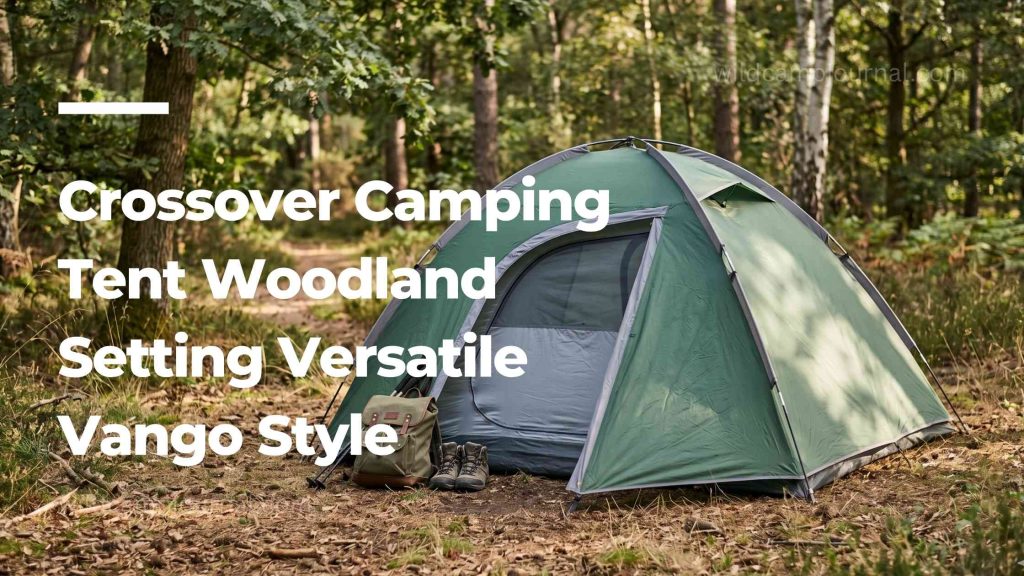
Price: $180–$220 | Capacity: 2-person | Weight: 1.8kg Flysheet HH: 2,500mm | Poles: Aluminium | Freestanding: Yes
The Vango Blade 200 sits in a genuine sweet spot — light enough to carry on moderate hiking routes, spacious enough for two adults with gear for a car camping weekend, and weatherproof enough for UK and Northern European conditions. It is not the best at either use case, but it handles both adequately at a price point that makes owning a single crossover tent logical.
Who it is right for: Campers who mix car camping and hiking and want one tent that handles both without breaking the bank or breaking their back.
Affiliate CTA: Check current price on Amazon → | Check at GO Outdoors →
Not sure which style suits you yet? This video reviews lightweight tents that work for both car camping and trail use.
Frequently Asked Questions
What is the main difference between a family tent and a backpacking tent?
The fundamental difference is design priority. Family tents prioritise living space, comfort, and durability for car camping where weight is irrelevant. Backpacking tents prioritise low weight and small packed size for hiking where every gram matters. Everything else — size, setup time, price, features — follows from that core difference.
Can a family tent be used for backpacking?
Not practically. The weight (typically 6–15kg) and packed size of a family tent make it physically unsuitable for carrying on a hiking trail. Even short distances with a heavy tent on your back — in addition to the rest of your gear — create a pack weight that is exhausting and potentially causes injury over time.
How heavy is too heavy for a backpacking tent?
As a general rule, your tent should weigh no more than 500g per person for comfortable multi-day backpacking. For a two-person tent this means a maximum of 1kg — though most backpackers accept up to 1.5kg per person for three-season trips. Anything above 2.5kg for a two-person tent starts to feel burdensome on full-day hiking routes.
What size tent do I need for a family of 4?
A family of four needs a tent rated for at least 6 people — ideally one with a room divider to give adults and children separate sleeping areas. Check the peak height to ensure adults can stand comfortably, and look for a vestibule large enough to store four people’s worth of footwear and wet gear.
Is a backpacking tent worth it if I only camp at established sites?
For established site camping only, a backpacking tent offers no practical advantage. You pay more for weight savings you will never benefit from and accept a cramped living space you never needed to accept. If you exclusively car camp at established sites, a family tent or mid-size 3-season tent is the right choice.
What is the best tent for someone who does both car camping and hiking?
A 3-person 3-season tent weighing under 2kg with aluminium poles and a minimum 2,000mm HH rating handles both use cases adequately. It is not the optimal tool for either — but it eliminates the need to own two tents while you determine which camping style you prefer. The Vango Blade 200 is a strong option in this category.
Conclusion
Family tents and backpacking tents are not competing products — they are tools designed for fundamentally different activities. Choosing between them is less about which tent is better and more about understanding which style of camping matches how you actually spend your time outdoors.
If your trips end at a car park and you value comfort, space, and a shelter that feels genuinely liveable over multiple nights, a family tent is the right investment. If your trips begin at a trailhead and you value the freedom to camp anywhere you can walk to, a backpacking tent earns its place in your pack despite its compromises on space.
And if you are still figuring out which kind of camper you are — start with a well-chosen crossover tent that handles both adequately, go camping as often as you can, and let experience make the decision for you.