There’s a particular kind of misery that comes from a camping trip that goes wrong not because of a storm or bad luck, but because of a gear decision you made weeks earlier in a shop or scrolling through Amazon at midnight. The tent that’s too small. The sleeping bag that sounded warm enough. The boots you “broke in” by wearing them around the house for an hour.
Camping gear mistakes are almost a rite of passage for beginners. The problem is, they don’t have to be. Most of the errors that ruin first trips are completely predictable and completely fixable with the right information before you head out.
Table of Contents
The Common 10 Camping Gear Mistakes – The Problem & Solution
This guide covers the 10 most common camping gear mistakes, why they happen, what the real-world consequences look like, and exactly what to do instead. Whether you’re planning your very first overnight or you’re three trips in and still not quite comfortable, this list will save you a lot of discomfort and probably a bit of money too.
Let’s start with the one mistake almost every single beginner makes.
Mistake #1: Buying a Tent Rated for Your Exact Group Size
Why it happens
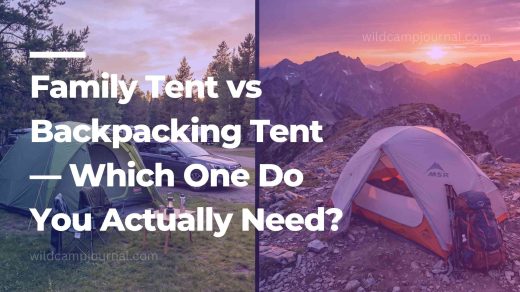
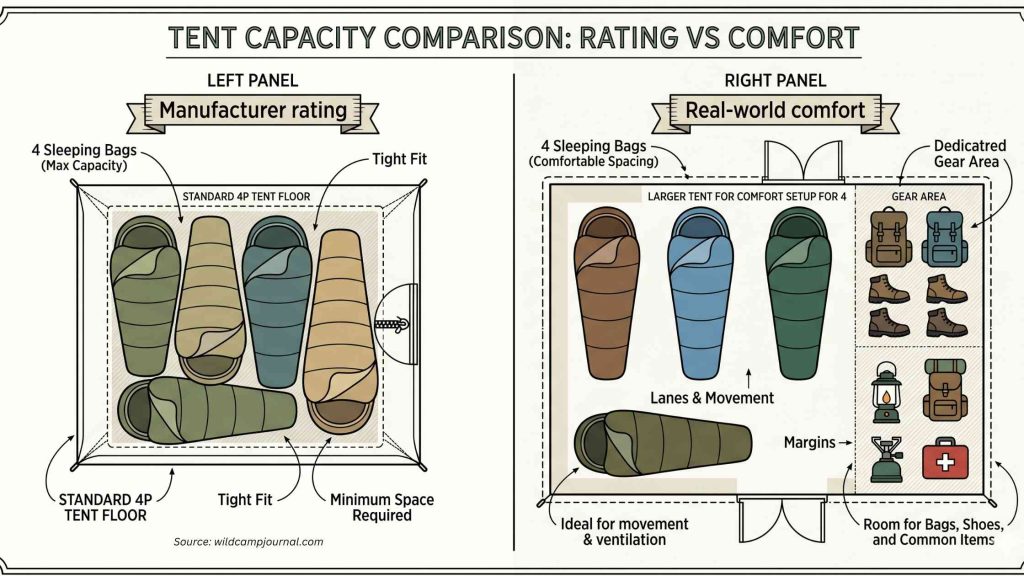
Tent manufacturers advertise their products by person capacity (2-person tent, 4-person tent, 6-person tent). It sounds logical: four people in your group, buy the 4-person tent. The problem is that this rating system is based on a military-style packing configuration that has almost nothing to do with how normal people sleep.
What the rating actually means
The “person rating” on a tent refers to the number of adult sleeping bags that can be laid side-by-side in the tent’s floor space — nothing more. There’s no allowance for your backpacks, your boots, your camp chairs, or the fact that humans generally prefer not to sleep pressed against a stranger.
A 4-person tent typically has a floor area of around 7–8 square metres. Divide that between four adults and their gear and you’re looking at less than 2 square metres per person — roughly the size of a single mattress, with no headroom to sit up and no space to store anything.
What this looks like in practice
Night one of a family camping trip: four people wedged into a tent that technically fits them. The youngest child kicks throughout the night. One parent’s sleeping bag is pressed against the tent wall and starts collecting condensation. Nobody can find their boots in the morning because they’re buried under three bags. By morning two, someone has booked a nearby B&B.
The Fix
Buy one size up from your group size — always. Two adults camping together should look at 3-person tents. A family of four needs a 6-person tent, preferably one with a divided sleeping area or an external gear vestibule. The extra size costs a little more and weighs slightly more if you’re carrying it, but the difference in comfort is enormous.
If weight is a concern because you’re backpacking rather than car camping, look for lightweight 2-person tents that are designed to actually fit two people — brands like MSR and Big Agnes size their backpacking tents more generously than budget alternatives.
Mistake #2: Choosing a Sleeping Bag by Price, Not Temperature Rating
Why it happens
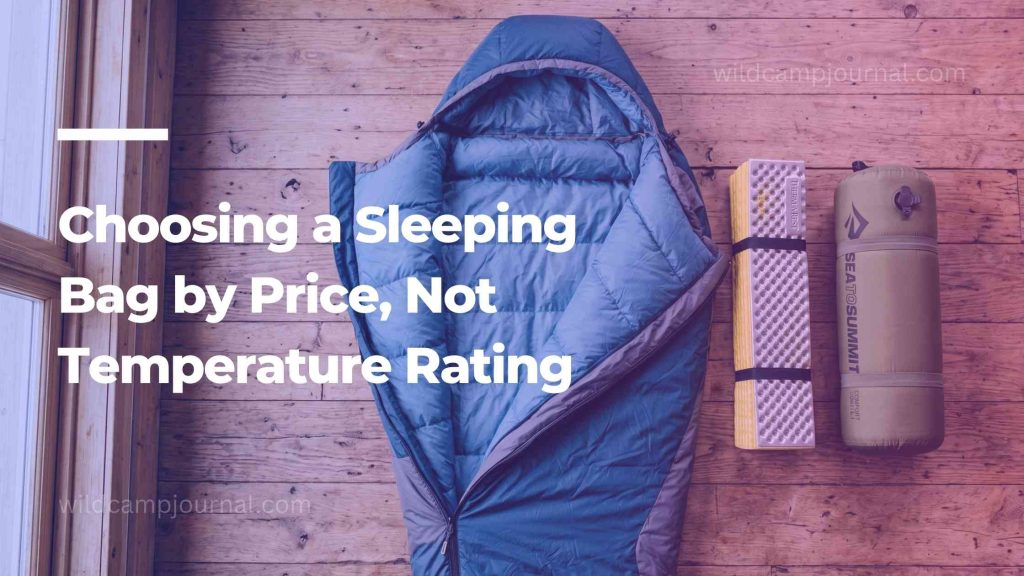
Sleeping bags sit in a wide price range — from £20 supermarket bags to £400 down expedition sacks. For a first trip, it’s tempting to start cheap. The problem isn’t the price itself; it’s that budget sleeping bags often either lack a meaningful temperature rating or use one that’s wildly optimistic.
Understanding temperature ratings
There are two numbers to know: the comfort rating and the lower limit rating. The comfort rating is the temperature at which an average adult woman will sleep comfortably through the night. The lower limit is the temperature at which an average adult man will survive without waking — but not sleep well.
Most bags are sold by their lower limit. A bag marketed as a “10°C bag” will keep an average man alive at 10°C. It will not keep that man comfortable, and it will not keep a woman comfortable at anywhere near 10°C.
What this looks like in practice
You check the weather forecast and it says overnight lows of 12°C. You buy the 10°C bag. At 3am, the temperature drops to 9°C and you’ve been awake for two hours, wearing your hiking fleece inside your sleeping bag, wondering why camping is considered a leisure activity.
The ISO 23537 specifies the requirements and test methods as well as provisions for labelling of adult sized sleeping bags for use in wild camps and leisure time activities.
The Fix
Find out the lowest expected temperature for your camping destination at the time of year you’re going. Then buy a bag rated at least 5°C below that. This buffer accounts for weather variation, the difference between comfort and survival ratings, and the fact that you’ll likely feel colder in the field than you expect.
For UK and Northern European camping, a comfort-rated 0°C to 5°C bag handles the vast majority of three-season conditions. If you’re camping in summer only, a comfort-rated 10°C bag is reasonable — but don’t push it.
Mistake #3: Skipping the Sleeping Pad
Why it happens
First-timers often focus entirely on the tent and sleeping bag and treat the sleeping pad as optional — or assume the sleeping bag alone will keep them warm. It’s a reasonable-sounding assumption that turns out to be completely wrong.
The science of ground cold
Here’s what most people don’t know: the ground conducts heat away from your body far faster than cold air does. Even on a mild night, lying directly on the earth will drain warmth from your back, hips, and legs at a rate no sleeping bag can compensate for, because sleeping bags work by trapping air — and the portion of the bag you’re lying on gets compressed flat and loses all its insulating value.
A sleeping pad addresses both problems: it provides a layer of insulation between you and the ground, and it keeps you off the compressed portion of your sleeping bag.
What this looks like in practice
You’ve spent £80 on a quality sleeping bag rated to 3°C. You skip the sleeping pad to save money. The ground is dry but hard and cold. By midnight you can feel the cold radiating up through the bag from below. You end up sleeping in every piece of clothing you brought. Your back aches for two days after.
The Fix
You don’t need an expensive sleeping pad to solve this problem. A basic closed-cell foam pad — the kind that rolls or folds and costs £15–25 — provides meaningful insulation and will last for years. If you want more comfort and pack size matters, self-inflating pads and inflatable air mats provide better cushioning and insulation at a higher price point.
The key metric to look for on inflatable pads is the R-value: a number representing insulation level. For three-season camping, look for an R-value of at least 2. For winter camping, aim for 4 or above.
Mistake #4: Wearing Cotton
Why it happens
Cotton is comfortable, familiar, and what most of us wear every day. It’s also one of the most dangerous fabrics you can choose for the outdoors — a fact that experienced campers and hikers summarise in three words: cotton kills.
Why cotton is a problem outdoors

Cotton absorbs moisture — sweat, rain, river splashes — and holds it against your skin. Unlike synthetic fabrics or wool, it has almost no ability to wick moisture away, and it dries extremely slowly. Wet cotton loses virtually all its insulating properties.
In mild conditions this is unpleasant. In cold conditions it becomes a genuine safety risk. A wet cotton t-shirt against your skin on a cool, windy evening can drop your core temperature fast enough to cause hypothermia — even when the air temperature is well above freezing.
What this looks like in practice
You wear your usual jeans and a cotton t-shirt for a day hike. It starts to drizzle. You sweat on the uphill sections. By the time you’re back at camp your base layer is soaked, the temperature has dropped with the sun, and you can’t get warm no matter how many layers you put on top.
The Fix
Replace cotton base layers with merino wool or synthetic alternatives (polyester, nylon) for any outdoor activity. Merino wool is particularly good: it wicks moisture, insulates even when damp, resists odour, and feels soft against skin. Synthetic fabrics dry faster and cost less.
Keep cotton for the campfire and the drive home. Leave it out of the backcountry entirely.
Mistake #5: Never Testing Gear Before the Trip
Why it happens
Life is busy, the trip is weeks away, and you tell yourself you’ll figure it out when you get there. You won’t — or rather, you will, but you’ll do it in the dark, probably in the rain, on ground you’ve never pitched a tent on before.
Why pre-trip testing matters
Every piece of camping gear has a learning curve, however small. Tent poles slot together in a specific order. Stoves need priming. Sleeping pads deflate at a specific valve position. These are all things you can figure out in your garden in five minutes — or spend forty frustrated minutes working out at a campsite while your family waits.
Testing gear also reveals defects. A tent with a faulty zip or a missing peg, a stove that won’t light, a sleeping mat with a slow puncture — all of these are simple to resolve before a trip and disasters during one.
The Fix
Do a backyard camp at least a week before any trip. Set up your tent from scratch. Cook a meal on your camp stove. Sleep a night on your sleeping pad. You’ll discover everything that needs attention while you still have time to fix it, return it, or replace it.
Mistake #6: Overpacking Food and Underpacking Water Treatment
Why it happens
Food is comforting and familiar to plan. Water feels like it’s always available — there’s a stream on the map, after all. This imbalance leads to bags stuffed with snacks and meals but no reliable way to make water safe to drink.
The real risk
Natural water sources — streams, rivers, lakes — look clean but can carry bacteria, parasites, and viruses that cause serious gastrointestinal illness. Drinking untreated water is one of the most common ways campers end up sick. Running out of clean water in a remote location is a genuine emergency.
Running low on trail mix, by contrast, is just a minor inconvenience.
The fix
Carry at minimum one reliable water treatment method on every trip: a portable filter (such as a Sawyer Squeeze or LifeStraw), chemical purification tablets, or a UV purifier like a SteriPen. Filters are the most versatile and handle most scenarios. Tablets are the lightest backup.
For food, pack with calorie density in mind rather than volume. Nut butters, jerky, hard cheeses, oats, and freeze-dried meals deliver high calories per gram and pack down small. Leave the family-sized snack bags at home.

✅ Lightweight less than 6 ounce
✅ Easy to use
✅ Perfect for outdoor adventures
✅ Manual Operation
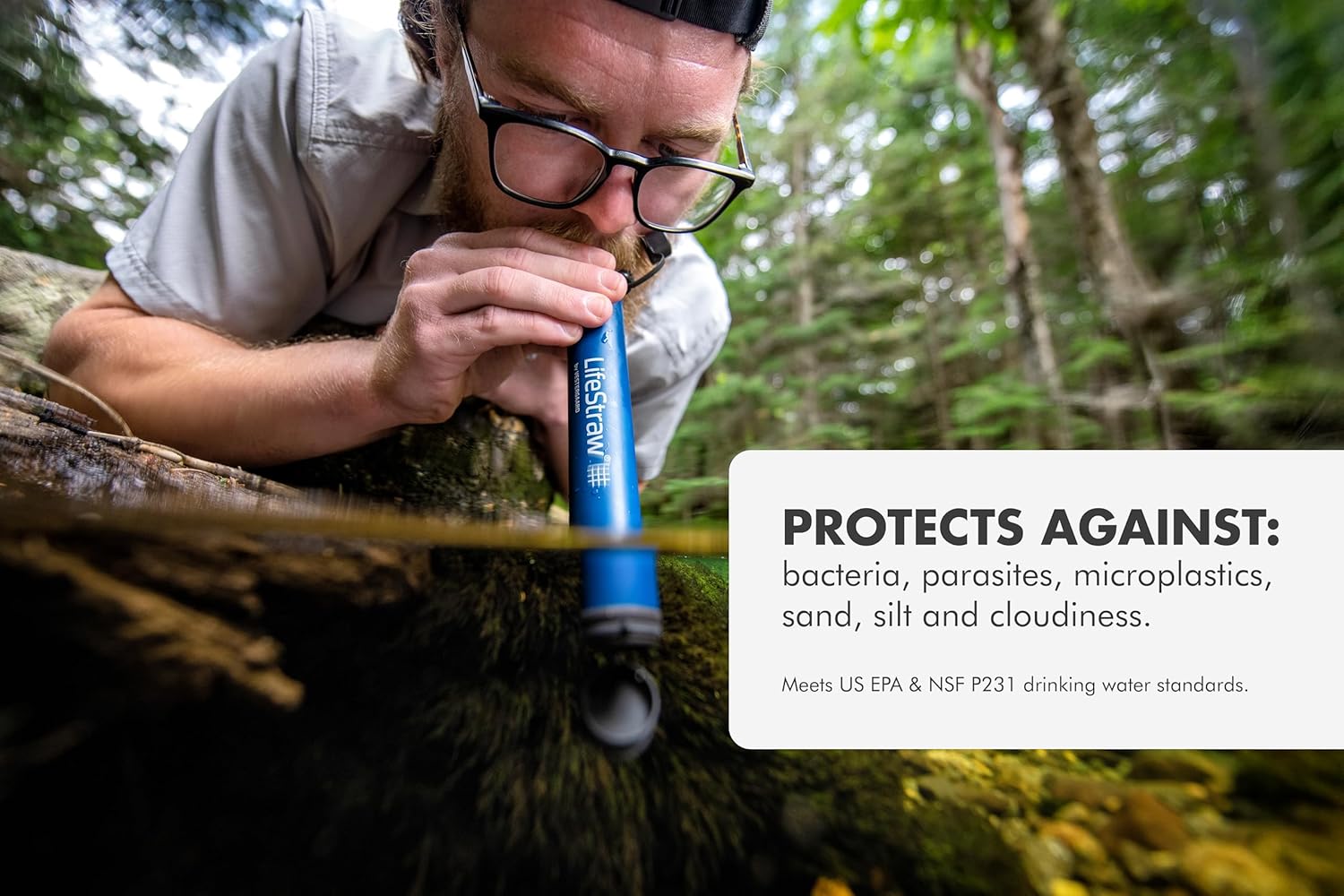
✅ Removes Bacteria & Parasites
✅ Removes Microplastics
✅ Rigorous Testing
✅ No Electricity Or Battery Power Required
Mistake #7: Relying Solely on Your Phone for Navigation
Why it happens
Smartphones are genuinely excellent navigation tools — when they have battery, signal, and a screen you can see in sunlight. Remove any one of those conditions and the navigation system you’ve relied on collapses completely.
What can go wrong
Phones die. They lose signal in valleys, forests, and remote terrain. Screens become unreadable in bright sunlight. Drop them on rocks and you lose the device entirely. Using a phone as your only navigation tool means accepting all of these failure modes as acceptable risks.
The Fix
Download offline maps before any trip (apps like OS Maps, AllTrails, and Maps.me all support offline use). Carry a portable charger. And for any trip into genuinely remote terrain, carry a paper 1:25,000 Ordnance Survey map, a compass, and know how to use them. A map and compass can’t run out of battery or lose signal.

Mistake #8: Choosing a Backpack Based on Looks
Why it happens
Backpack marketing leans heavily on aesthetics and brand identity. Many people choose their first pack based on colour, style, or brand recognition without understanding the more important factors.
Why fit matters more than anything else
A backpack transfers load to your body in one of two ways: onto your shoulders, or onto your hips. A correctly fitted pack with a properly adjusted hip belt transfers 70–80% of the weight to your hips and to the strongest part of your body for carrying load. A poorly fitted pack dumps it all onto your shoulders, which causes pain and fatigue within a few kilometres.
Torso length is the distance from your C7 vertebra (the bony bump at the base of your neck) to your iliac crest (the top of your hip bones), they are the key measurement. Most packs come in multiple torso sizes. Using the wrong size makes the hip belt land in the wrong place, and the load transfer fails.
The Fix
Measure your torso length before buying any pack. If possible, try packs on in-store with weight loaded in them as most outdoor retailers will load a pack to your specification so you can feel how it carries. For backpacking, prioritize fit over capacity, brand, and price.
Mistake #9: Forgetting a Headlamp (or Bringing Just One)
Why it happens
“I’ll use my phone torch” is one of the most common pieces of logic that unravels on a camping trip. Phones have torches, yes! but phone torches drain the battery you need for navigation, music, and emergency communication, and they require you to hold the phone in your hand, which leaves you with one free hand for everything else.
Why headlamps are non-negotiable
Camp life after dark involves two-handed tasks: cooking, setting up a bear hang, pegging out a guy rope in rain, applying first aid, finding lost items in a tent. A headlamp frees both hands and leaves your phone battery untouched.
The second common mistake is bringing only one headlamp for a group. Bulbs fail. Batteries die. People wander off in different directions. One headlamp between four people creates bottlenecks and dependency.
The Fix
Budget one headlamp per person. For group camping, add a single camp lantern for the communal area; this means nobody has to wear a headlamp during dinner. Modern headlamps are cheap (a reliable 100-lumen model costs under £20), lightweight, and last hundreds of hours on a set of batteries.
Mistake #10: Leaving First Aid to Chance
Why it happens
First-time campers often underestimate the likelihood of minor injuries. It’s just a weekend. Nothing’s going to go wrong. The campsite’s not that remote.
What actually happens
Blisters happen on almost every trip that involves more than a few kilometres of walking. Cuts from knives, axes, and rough terrain are common. Insect stings range from annoying to medically significant. Twisted ankles happen on uneven ground. Sunburn happens when people forget that UV exposure is higher at altitude and in open terrain.
None of these are likely to be serious but all of them become more serious without treatment, and all of them are miserable to deal with when you have nothing in your bag.
The Fix

Carry a compact first aid kit on every trip. At minimum, it should include blister plasters, adhesive bandages in assorted sizes, antiseptic wipes, sterile gauze pads, medical tape, ibuprofen and/or paracetamol, antihistamine tablets, a triangular bandage, and any personal medications.
More importantly, know how to use what’s in the kit before you need it. A first aid course from St John Ambulance or the Red Cross covers the essentials in a single day and is one of the best investments any regular outdoor person can make.
Summary: Quick-Reference Checklist

Before your next camping trip, run through this list:
- ✅ Tent is one size larger than your group count
- ✅ Sleeping bag has a comfort rating at least 5°C below expected lows
- ✅ Sleeping pad is packed (R-value appropriate for season)
- ✅ No cotton in your base layer or mid-layer clothing
- ✅ All gear has been tested at home at least once
- ✅ Water treatment method is packed
- ✅ Offline maps downloaded; paper map and compass for remote trips
- ✅ Pack has been fitted to your torso length
- ✅ One headlamp per person; spare batteries packed
- ✅ First aid kit is complete and you know how to use it
Frequently Asked Questions
What is the most common camping gear mistake beginners make?
The most common mistake is buying a tent based on its person rating without understanding that tent capacity ratings are based on maximum occupancy with no gear which are not comfortable for sleeping. Always buy one size larger than your actual group.
Do I really need a sleeping pad if I have a good sleeping bag?
Yes. A sleeping bag compresses under your body weight and loses its insulation on the side you’re lying on. Without a sleeping pad, the cold ground conducts heat away from you faster than any sleeping bag can compensate for. Even a basic foam pad makes a significant difference.
Is a £20 sleeping bag good enough for camping?
For summer camping with mild overnight temperatures (above 15°C), a budget bag can be adequate. For anything cooler, invest in a bag with a reliable temperature rating. Look for EN 13537 or ISO 23537 testing standards, which guarantee the rating was tested objectively.
What clothing should I avoid wearing camping?
Avoid cotton as a base layer or in any layer that sits against your skin. Cotton absorbs moisture and loses its insulating properties when wet. Choose merino wool or synthetic fabrics instead. Jeans are particularly problematic because they’re heavy, slow to dry, and restrictive when hiking.
How do I know if my backpack fits correctly?
The hip belt should sit centered on your iliac crest (the bony top of your hip). When the belt is buckled and tightened, most of the pack’s weight should feel like it’s resting on your hips, not hanging from your shoulders. The shoulder straps should make light contact with your shoulders without bearing the main load.
Can I use my phone instead of a dedicated GPS device for navigation?
Yes, provided you download offline maps before leaving, carry a portable charger, and understand the phone’s limitations (screen visibility in sunlight, vulnerability to damage, battery drain). For any serious backcountry route, carry a paper map as a backup.
What should a basic camping first aid kit include?
At minimum: blister plasters, adhesive bandages (assorted sizes), antiseptic wipes, sterile gauze pads, medical tape, ibuprofen or paracetamol, antihistamine tablets, a triangular bandage, and any personal medications. Pre-assembled kits from Lifesystems or Adventure Medical Kits cover these bases for around £20–30.
Conclusion
Most camping trips don’t fail but the ones that do almost always trace back to the same avoidable gear decisions. A tent that’s too small. A sleeping bag that sounds warm enough but isn’t. A backpack that looked great in the shop but destroys your shoulders after two hours on trail.
The good news is that all ten of these mistakes are easy to fix once you know what to look for. You don’t need to spend a fortune but you need to spend wisely, test thoroughly, and prepare before you go rather than improvising in the field.
Pick the fixes that apply to your next trip, work through the checklist above, and you’ll already be better prepared than the majority of first-time campers who show up having done none of this. The outdoors is worth the effort and a well-prepared trip is a completely different experience from one where everything goes slightly wrong.
Happy camping.