Of all the gear decisions you make before a camping trip, choosing the wrong sleeping pad is the one that costs you the most sleep and gets the least attention before you buy.
Most beginners spend time comparing sleeping bags and tents. They treat the sleeping pad as an afterthought, pick whatever is cheapest, and then spend the night cold and uncomfortable wondering what went wrong. The sleeping bag gets the blame. The pad is almost always the real problem.
Table of Contents
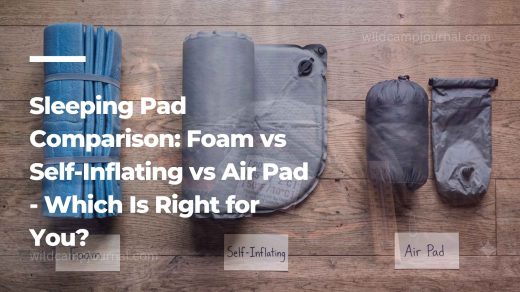
This sleeping pad comparison covers all three types available in 2026: closed-cell foam, self-inflating, and air pads. You will learn what each type does well, where each one falls short, which R-value you need for your camping season, and which specific pads to buy on Amazon.com at every budget and use case.
There is no single best sleeping pad for everyone. There is a best sleeping pad for you, and this guide will help you find it.
Prefer to watch first? This video walks through R-value, comfort, and weight in plain language before you compare pad types.
Why Your Sleeping Pad Matters More Than Your Sleeping Bag
The ground conducts heat away from your body far faster than cold air does. When you lie down inside your sleeping bag, the insulation underneath you compresses completely under your body weight and loses virtually all its warming ability. Your sleeping bag keeps your top half warm. Without a sleeping pad, nothing keeps your bottom half warm.
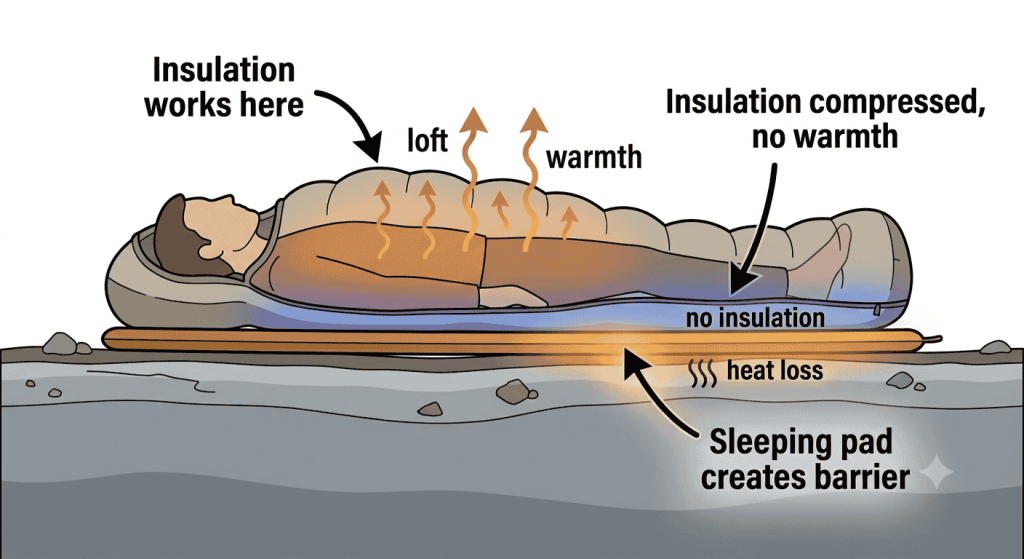
This is why experienced campers treat the sleeping pad as the foundation of their sleep system, not an optional add-on. A quality sleeping bag on a thin or absent pad will leave you cold at temperatures well above the bag’s stated rating. A modest sleeping bag on a well-chosen pad will keep you warmer than a premium bag with no pad underneath.
We covered this in detail in our guide to common camping gear mistakes. Skipping the sleeping pad is one of the most common and most avoidable errors beginners make.
When choosing your pad, pair it with your sleeping bag’s temperature rating. For the full guide on how sleeping bag and pad ratings work together, read our sleeping bag temperature rating guide.
What to Know Before You Compare
Before comparing pad types, you need to understand three things: R-value, thickness, and width. These three factors determine whether a pad actually works for your conditions, not brand names or marketing language.
R-Value: The Number That Actually Matters
R-value measures how well a sleeping pad resists heat flowing from your body into the ground. Higher R-value means better insulation. Lower R-value means more cold transfers through the pad from the ground below.
The ASTM F3340 standard is now the required testing method for all sleeping pad R-values sold in the US market. This means R-values from different brands are now directly comparable, which was not always the case before standardised testing was required.
Use this table to match your R-value to your camping season:
| Season | Overnight Low Temperature | Minimum R-value |
|---|---|---|
| Summer | Above 50 degrees F | R 1 to 2 |
| Three-season | 25 to 50 degrees F | R 3 to 4 |
| Cold weather | 10 to 25 degrees F | R 4 to 5 |
| Winter | Below 10 degrees F | R 5 or above |
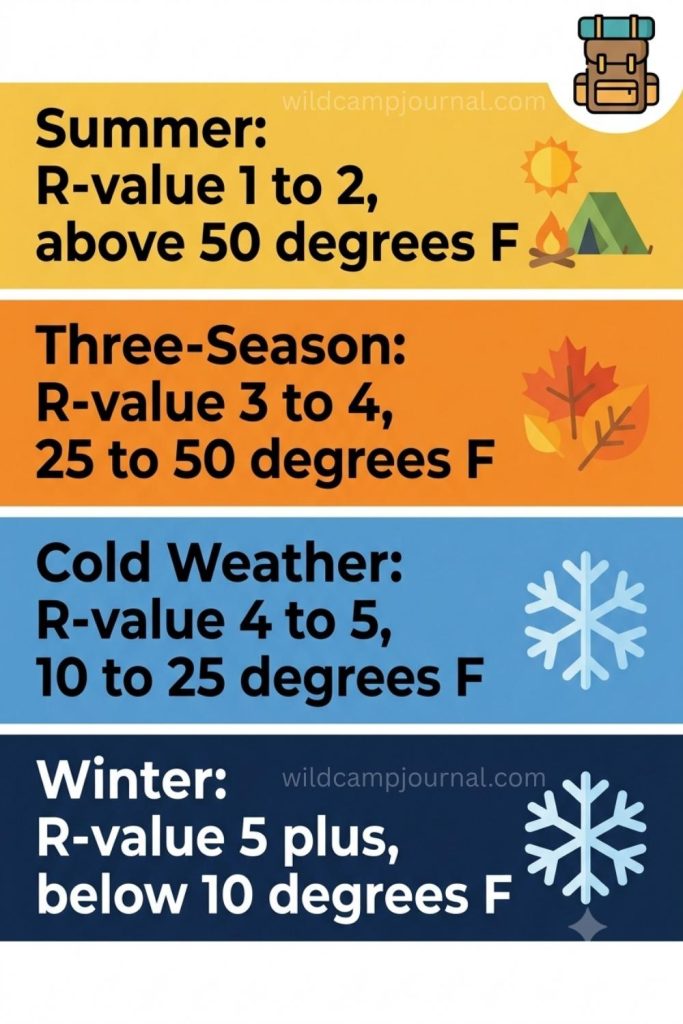
One important note: R-values are additive. If you stack a foam pad with an R-value of 2 under an air pad with an R-value of 3, your combined system has an R-value of 5. This is a practical strategy used by thru-hikers and cold-weather campers who need warmth without the weight of a single high-R-value pad.
Still unsure which R-value is right for your conditions? This video explains how R-value works in real camping temperatures with practical examples.
Thickness: How Much Do You Actually Need?
A fully inflated pad should provide at least 2.5 inches of cushion for back sleepers and at least 3 inches for side sleepers. Below those thresholds, most campers will bottom out during the night, meaning their hip or shoulder compresses the pad completely and contacts the ground.
A thicker pad is not always better. Thicker air pads weigh more and cost more. For backpacking, 3 inches of loft on a quality air pad is more than enough for most sleepers. For car camping where weight is not a concern, 4 inches or more delivers a noticeably better night’s sleep.
Width: Regular vs Wide
Standard sleeping pad width is 20 inches. Wide pads run 25 inches. The width you need depends on your shoulder width and how much you move during sleep.
Most average-build adults sleep comfortably on a standard 20-inch pad. Broad-shouldered campers, active sleepers who roll during the night, and side sleepers who need hip clearance benefit from a 25-inch wide pad. The trade-off is weight and price: wide pads cost more and weigh more, which matters for backpacking but is irrelevant for car camping.
Closed-Cell Foam Pads

What They Are and How They Work
Closed-cell foam pads are made from dense foam packed with tiny sealed air pockets. The sealed cells prevent air and moisture from passing through the material, creating a consistent insulating barrier between you and the ground. They require no inflation and no setup. Unroll or unfold them and they are ready to sleep on.
Most closed-cell foam pads fold accordion-style for easier packing or roll into a cylinder. Their R-value typically falls between 1.5 and 2.5, which makes them appropriate for summer camping and adequate for mild three-season nights when paired with a suitable sleeping bag.
Who Foam Pads Are Right For
Foam pads are the right choice for summer car campers on a tight budget, thru-hikers who cannot afford to deal with a puncture in the backcountry, and any camper who wants a reliable and inexpensive backup pad to pair with an inflatable. If you sleep on your back and camp in summer or mild three-season conditions, a foam pad is a completely functional choice at the lowest possible cost.
Pick 1: NEMO Switchback Sleeping Pad
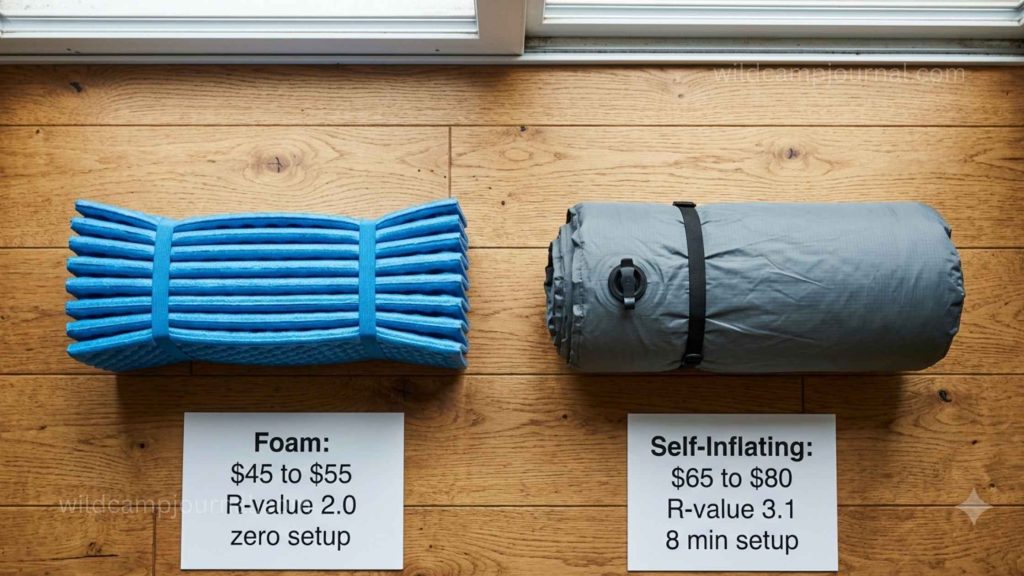
Price: $45 to $55 | Type: Closed-cell foam | R-value: 2.0 Weight: 14.2 oz | Thickness: 0.9 inches | Packed size: 20 x 6 x 5 inches
The NEMO Switchback is the most field-tested budget foam pad in the US market and consistently recommended by OutdoorGearLab, CleverHiker, and GearJunkie as the top foam pad for backpacking. The egg-crate surface pattern creates air channels that improve comfort beyond what flat foam provides. It folds accordion-style rather than rolling, which makes it more packable than cylindrical alternatives. At 14.2 ounces it is genuinely lightweight for a foam pad, and at R-2.0 it handles summer and mild three-season camping reliably.
Who it is right for: Budget backpackers doing summer trips, thru-hikers who want puncture-proof reliability, and car campers wanting a cheap reliable backup pad.

Price: $45 to $55
Type: Closed-cell foam
R-value: 2.0 Weight: 14.2 oz
Thickness: 0.9 inches
Packed size: 20 x 6 x 5 inches
Self-Inflating Pads
What They Are and How They Work
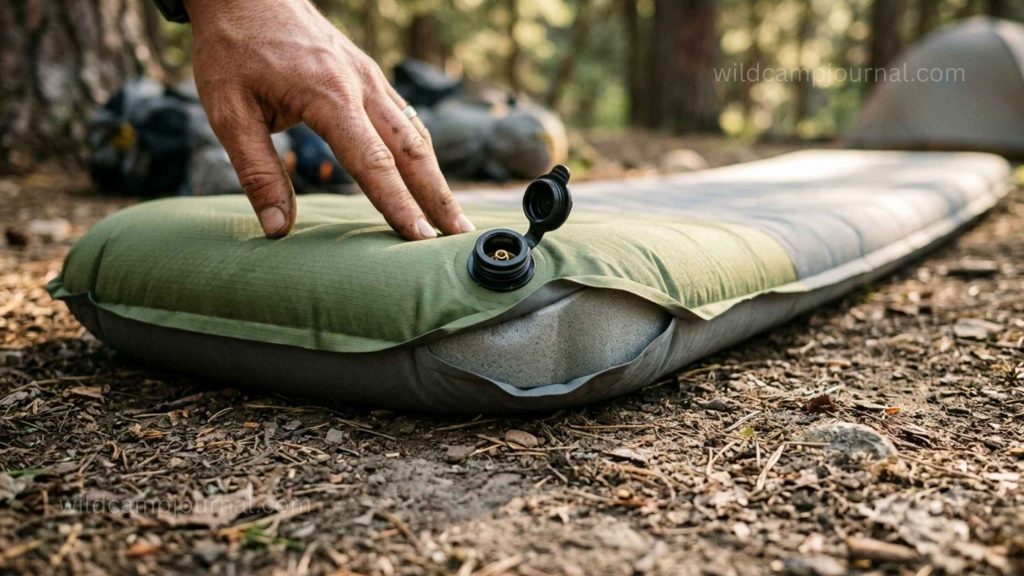
Self-inflating pads combine an open-cell foam core inside an airtight shell. When you unroll the pad and open the valve, the foam expands and automatically draws air in from the surrounding environment. After 5 to 10 minutes the pad is mostly inflated. You close the valve, add a few breaths through the valve to reach your preferred firmness, and the pad is ready.
The foam core does two things simultaneously: it insulates you from the ground independently of the air inside, and it provides structural cushioning that maintains consistent support regardless of how you move during sleep. R-values on self-inflating pads typically range from R-2 on thin backpacking models to R-5 on thicker car camping models, covering most three-season and cold-weather conditions.
Who Self-Inflating Pads Are Right For
Self-inflating pads are the best choice for car campers who want comfort without the complexity of air pads, three-season campers who need warmth above what foam provides, beginners who want a reliable and low-maintenance pad, and anyone who finds air pad inflation inconvenient.
Pick 2: Therm-a-Rest Trail Scout Self-Inflating Pad
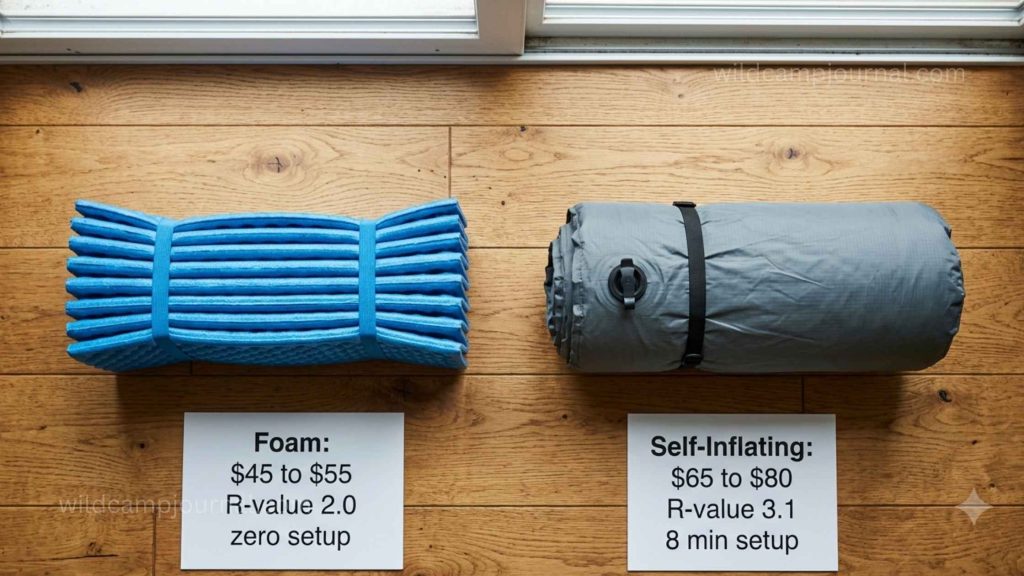
Price: $65 to $80 | Type: Self-inflating | R-value: 3.1 Weight: 2 lbs 1 oz | Thickness: 1.5 inches | Packed size: 11 x 25 inches rolled
The Therm-a-Rest Trail Scout is the most widely recommended entry-level self-inflating pad for car camping in the US market. REI Expert Advice includes it in their top picks for car camping sleeping pads updated June 2026. The 3.1 R-value covers three-season camping reliably. The self-inflation works without assistance in around 8 minutes. The 1.5-inch foam core provides consistent support that holds up across a full night without the mid-night deflation that affects some air pads.
Who it is right for: Car campers and three-season campers who want reliable warmth and consistent comfort without managing an air pad inflation system.
Price: $65 to $80
Type: Self-inflating
R-value: 3.1
Weight: 2 lbs 1 oz
Thickness: 1.5 inches
Packed size: 11 x 25 inches rolled
Pick 3: Therm-a-Rest ProLite Plus Self-Inflating Pad (Premium Three-Season)
Price: $120 to $140 | Type: Self-inflating | R-value: 3.8 Weight: 1 lb 9 oz | Thickness: 1.5 inches | Packed size: 11 x 25 inches rolled
For campers who want the durability and simplicity of a self-inflating pad but need performance closer to an air pad, the Therm-a-Rest ProLite Plus bridges the gap. The cored foam construction removes material from the centre of the foam cells to reduce weight while maintaining structural integrity, bringing the weight down to 1 lb 9 oz without sacrificing the foam core’s support. The R-value of 3.8 handles cold autumn and early winter camping reliably. It is light enough for moderate backpacking trips while comfortable enough for car camping.
Who it is right for: Campers who split time between car camping and hiking and want one self-inflating pad that handles both without choosing between comfort and packability.
Price: $120 to $140
Type: Self-inflating
R-value: 3.8 Weight: 1 lb 9 oz
Thickness: 1.5 inches
Packed size: 11 x 25 inches rolled
Air Pads
What They Are and How They Work
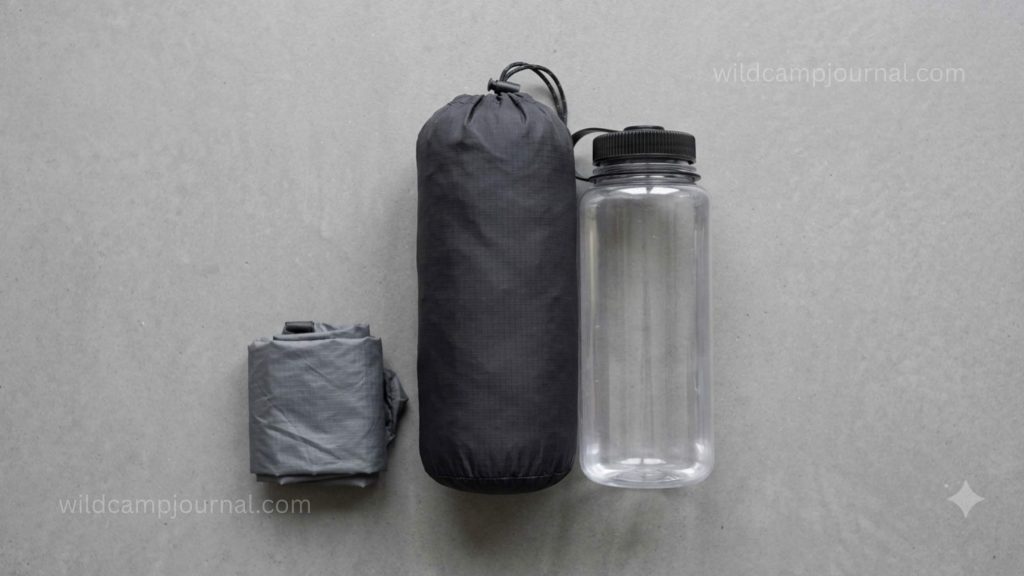
Air pads use welded airtight fabric chambers filled by mouth, pump sack, or a built-in pump mechanism. There is no foam core. Insulation comes from the air itself combined with reflective barriers inside the chambers, synthetic fill between the baffles, or both. This construction allows air pads to achieve the highest R-values of any pad type while packing down to the size of a one-litre water bottle.
Air pads range from basic uninsulated summer models with R-values below 2, to heavily insulated winter models with R-values above 7. Thickness typically ranges from 2.5 to 4.6 inches on premium models, delivering a comfort level that closed-cell foam and most self-inflating pads cannot approach.
Who Air Pads Are Right For
Air pads are the best choice for backpackers where pack weight is a genuine constraint, side sleepers who need maximum loft for pressure relief, cold-weather campers who need high R-values at the lowest possible weight, and car campers who want the most comfortable sleep available regardless of cost.
Pick 4: Klymit Static V2 Sleeping Pad (Budget Air Pad)
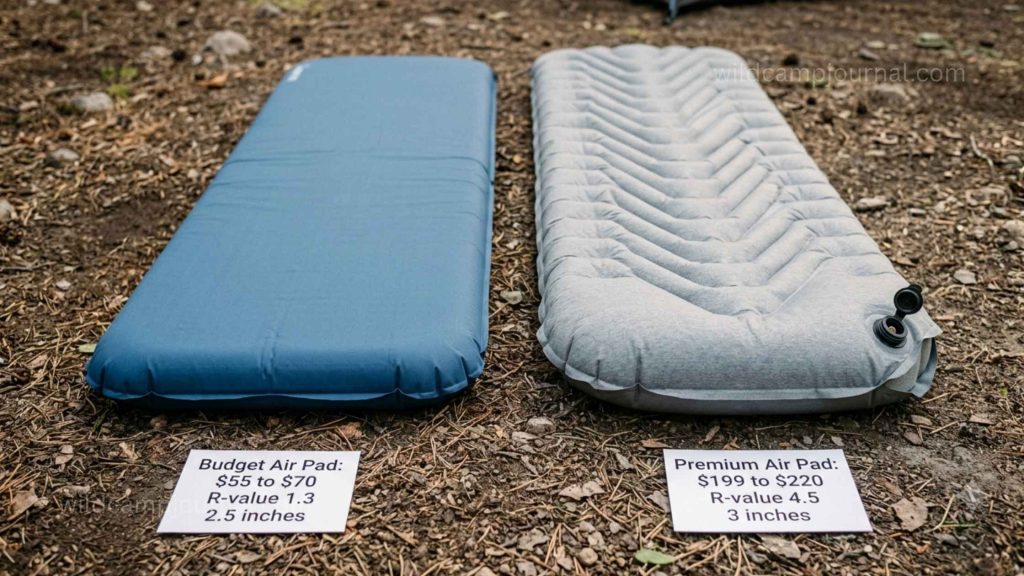
Price: $55 to $70 | Type: Air pad | R-value: 1.3 Weight: 18 oz | Thickness: 2.5 inches | Packed size: 8 x 3.5 inches
The Klymit Static V2 is the most recommended budget air pad in the US market. OutdoorGearLab and GearJunkie both include it in their top picks for budget backpacking pads in 2026. The V-chamber design limits lateral air movement which reduces the rolling sensation common on basic flat-baffle air pads. At 2.5 inches thick it provides adequate cushion for back sleepers on most terrain. The R-value of 1.3 limits it to summer and mild conditions, so pair it with a foam pad in colder weather to stack R-values.
Who it is right for: Summer backpackers and budget car campers who want an air pad’s packability and comfort without spending over $70.
Price: $55 to $70
Type: Air pad
R-value: 1.3
Weight: 18 oz
Thickness: 2.5 inches
Packed size: 8 x 3.5 inches
Pick 5: Therm-a-Rest NeoAir XLite NXT Sleeping Pad (Premium Backpacking)
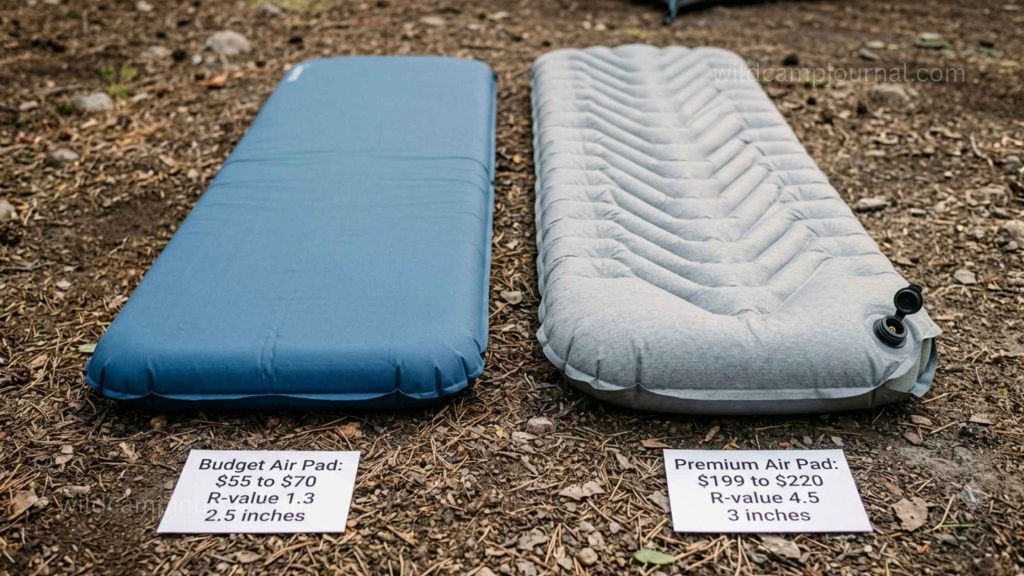
Price: $199 to $220 | Type: Air pad | R-value: 4.5 Weight: 12 oz | Thickness: 3 inches | Packed size: 9 x 4 inches
The Therm-a-Rest NeoAir XLite NXT is the benchmark ultralight sleeping pad in the US market and has held that position through multiple updated versions. OutdoorGearLab, CleverHiker, GearJunkie, and Backpacker Magazine all rate it among the top two or three backpacking pads available in 2026. At 12 ounces it is significantly lighter than any self-inflating pad at the same R-value. The R-value of 4.5 handles three-season camping and cold shoulder season conditions. The Triangular Core Matrix baffles create a stable sleeping surface that does not roll or shift during sleep, which is the most common comfort complaint with budget air pads.
Who it is right for: Backpackers who want the lightest possible pad at genuine three-season warmth, and car campers willing to invest in the most packable high-performance pad available.
Price: $199 to $220
Type: Air pad
R-value: 4.5
Weight: 12 oz
Thickness: 3 inches
Packed size: 9 x 4 inches
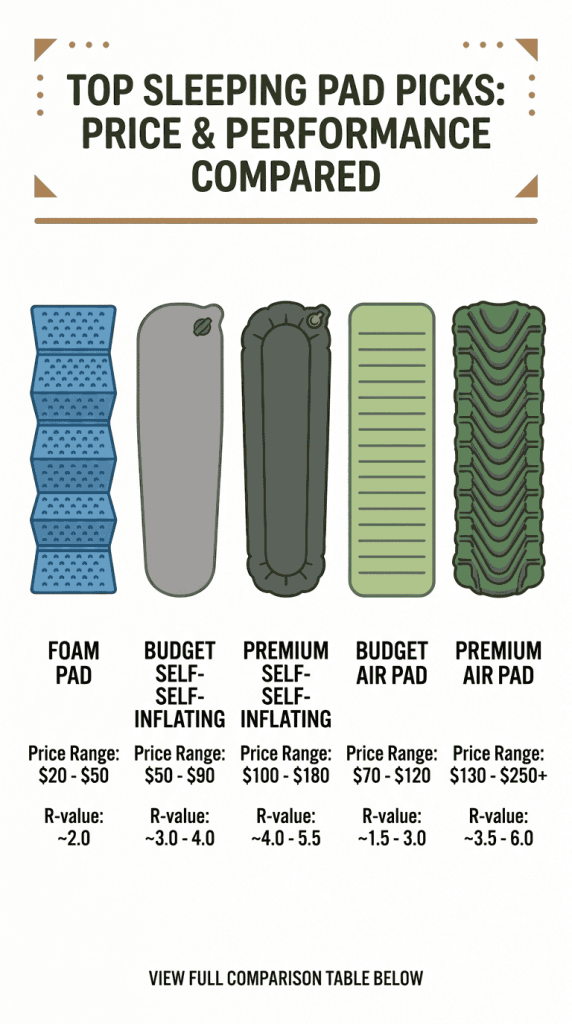
Sleeping Pad Comparison Table
Which Sleeping Pad Is Right for You?
Choose a Foam Pad If
You camp exclusively in summer. Your budget is under $55. You are doing a long trail where a punctured pad would be catastrophic. You want a backup pad to stack under an air pad for extra warmth. You sleep on your back and comfort is less important than reliability.
Choose a Self-Inflating Pad If
You primarily car camp and weight does not matter. You want three-season warmth without managing air pad inflation. You are a beginner who wants a reliable and low-maintenance option. You want better comfort than foam without paying air pad prices. You find air pad inflation inconvenient or impractical.
Choose an Air Pad If
You backpack regularly and pack weight is a genuine constraint. You are a side sleeper who needs 3 inches or more of loft for pressure relief. You need high R-values for cold-weather camping at the lowest possible weight. You want the most comfortable sleep available and budget is not the primary concern.
Using Two Pads Together
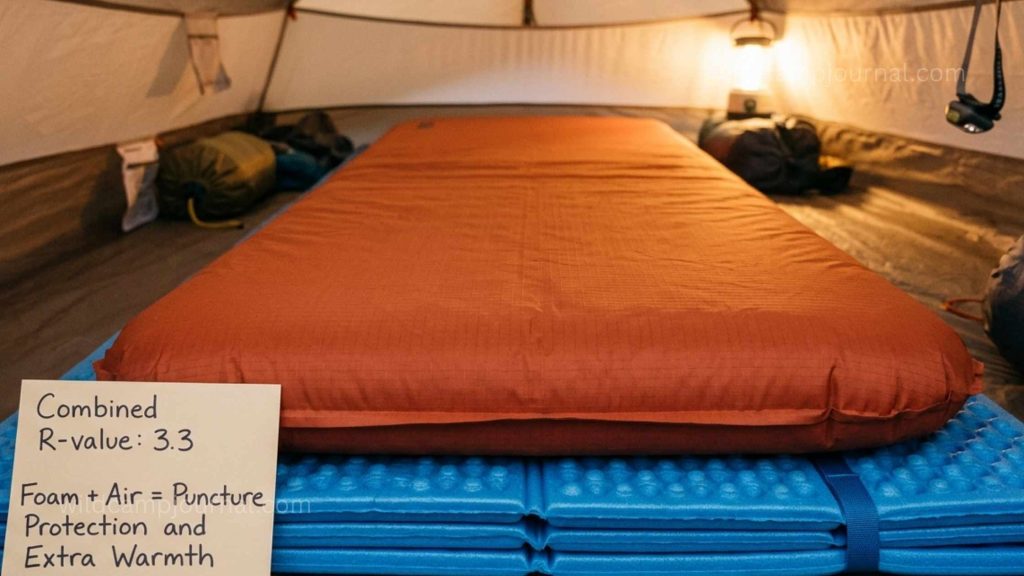
Stacking a foam pad under an air pad is a strategy used by many experienced thru-hikers and cold-weather campers. The foam base adds its R-value to the air pad’s R-value, increasing total insulation without adding an expensive high-R-value single pad. The foam also protects the air pad from punctures by creating a barrier between the inflatable fabric and the rough ground.
A practical example: NEMO Switchback at R-2 under a Klymit Static V2 at R-1.3 gives a combined R-value of 3.3 for a total cost of around $100 to $125. That matches or exceeds the warmth of many self-inflating pads costing $150 or more, with the added benefit of puncture protection on the air pad.
Still deciding between foam and air? This direct comparison video shows both pad types in real use so you can see the trade-offs before you buy.
Frequently Asked Questions
What is the most comfortable sleeping pad?
For car camping, the most comfortable sleeping pads are thick self-inflating models or premium air pads in the 3.5 to 4.6 inch range. The Therm-a-Rest NeoAir XLite NXT at 3 inches is the most comfortable packable option for backpacking. For car camping with no weight concern, the Exped MegaMat and Therm-a-Rest NeoLoft both offer a sleep quality that most campers describe as comparable to a home mattress.
What sleeping pad is best for side sleepers?
Side sleepers need a minimum of 3 inches of pad thickness to keep their hip and shoulder from contacting the ground. Air pads in the 3 to 4 inch range are the best choice for side sleepers. The Therm-a-Rest NeoAir XLite NXT and Klymit Static V Base in a wide size are both strong options for side sleepers who also backpack. For car camping, any 3 to 4 inch self-inflating or air pad handles side sleeping reliably.
Is a thicker sleeping pad always better?
Not for backpacking. Thicker air pads weigh more and cost significantly more. For most back sleepers, 2.5 to 3 inches is sufficient. For side sleepers, 3 inches is the practical minimum. Beyond 4 inches the comfort improvement becomes marginal while the weight and cost increase continues. For car camping where you carry the pad from a vehicle, a thicker pad is generally a straightforward comfort upgrade with no meaningful trade-off.
What is the best budget sleeping pad for camping?
For summer car camping and backpacking, the NEMO Switchback foam pad at $45 to $55 is the best budget option for reliability and durability. For budget backpackers who want an air pad, the Klymit Static V2 at $55 to $70 is the most recommended option across independent US review sites in 2026. For three-season car camping, the Therm-a-Rest Trail Scout at $65 to $80 provides the best balance of warmth, comfort, and price.
What can you use instead of a sleeping pad?
In a pinch, folded blankets, a yoga mat, or an emergency mylar bivvy sheet can provide a minimal insulating layer between you and the ground. None of these substitutes come close to a dedicated sleeping pad in warmth or comfort. A closed-cell foam pad costs under $50 and outperforms any improvised alternative significantly. If you are car camping and forget your pad, a folded moving blanket or thick yoga mat is a workable one-night solution for mild conditions.
Conclusion
There is no single best sleeping pad for every camper. The best pad for you depends on how you camp, what season you camp in, and how much you are willing to carry.
Foam pads are the most reliable and the least expensive. They belong in summer kit and in the hands of any camper who values durability above comfort. Self-inflating pads sit between foam and air in every category: more comfortable than foam, more durable than air pads, heavier than both at equivalent performance. They are the practical default for car camping across three seasons. Air pads are the lightest and most comfortable option, with R-values that cover every season. They are the right choice for backpackers and for anyone who wants the best possible sleep in a camping context.
Buy the pad that matches how you actually camp, not the most expensive or most technical option. Get the R-value right for your season, the thickness right for your sleeping position, and the weight right for how you carry it. Do those three things and your sleep system will work.